
Long-Range Hunting: A Practical Guide to Making the Shot (and Knowing When Not To)

DuraCoat Certified Applicator · 25+ years
There's a moment every long-range hunter knows. The animal's out there, farther than you've ever shot at game, and the wind's doing something you don't quite trust. You can dial it. The rifle's capable. But should you? That single question separates long-range hunting from long-range shooting, and most of the internet skips right past it.
I've spent decades behind precision rifles, building them, coating them, and teaching people to run them in the field. So I'm going to give you the honest version of this guide, not the one that tells you a 1,000-yard kill makes you a better hunter. Long-range hunting is a real, learnable skill. It's also one with a hard ethical edge, and the best shooters I know are defined as much by the shots they pass as the ones they take.
Here's everything that actually matters: what "long range" really means, how far is too far, the rifle and data behind a clean hit, and the practice that ties it together.
Key takeaways
- "Long range" is defined more by intent than by a number. The Boone and Crockett Club judges it by whether you're hunting or just testing equipment on a live animal.
- As of 2026, the 6.5 Creedmoor is chambered in more new US civilian rifles each year than any other cartridge, but the "best" caliber is the one you shoot consistently.
- Shots are won with verified DOPE, a turret you trust, and wind-reading, not the priciest rifle.
- The skill you can't buy is practice. A capable rig with an unpracticed shooter behind it is how animals get wounded.
First, what actually counts as "long-range" hunting?
Ask ten hunters and you'll get ten numbers: 400 yards, 600, 800, "anything past where I'm comfortable." That last one's closest to the truth. The Boone and Crockett Club, the country's oldest fair-chase organization, deliberately refuses to pin long-range hunting to a fixed distance, defining it instead by intent (Boone and Crockett Club, Position Statement: Long Range Shooting). If the goal is to hunt the animal, that's one thing. If it's to test how far you can hit a live target, that's another thing entirely.
So a useful working definition: long-range hunting starts at the distance where you have to do something extra to guarantee the hit: dial elevation, account for wind, read angle and density altitude. For one shooter that's 350 yards. For a trained one with a dialed rig, it might be 700. The number isn't the point. The honesty about your own limit is.
How far is too far? The question most guides dodge
This is the uncomfortable part, and it's the most important section here. The Boone and Crockett Club's position is blunt: long-range shooting can take unfair advantage of an animal, stripping away its natural ability to detect danger, and their advice to hunters is one line worth tattooing on your scope cap: "if in doubt, stretch the stalk, not the shot" (Boone and Crockett Club, 2024).
I agree with that, and I sell long-range capability for a living. Here's my own rule, built from years of watching shots land and watching them go wrong: your ethical maximum is the distance at which you can put every round into the vital zone, on demand, from a field position, in the actual conditions, not your best group off a bench on a calm day. Wind doubt? Pass. Marginal rest? Pass. Light fading and a quartering animal? Pass. A wounded animal you can't recover is the one outcome no trophy justifies. The shooters I respect most are ruthless about this, and it's the first thing we drill in our long-range training.
Building the rifle: caliber, bullet, and the cartridge question
What cartridge should you hunt long range with? The honest answer frustrates people: the best caliber is the one you'll shoot enough to master, that carries enough energy and a high-BC bullet to your maximum range. As of 2026, the 6.5 Creedmoor is chambered in more new US civilian rifles each year than any other cartridge (PrecisionRifleBlog, Best Rifle Cartridge, 2025). That popularity isn't hype. It recoils mildly enough to practice often, shoots flat, and kills cleanly on most North American game.
That said, don't get lost in the cartridge wars. A 6.5 Creedmoor, .280 Ackley, 7 PRC, or .300 Win Mag will all do the job inside sane ranges. What separates a hitter from a misser isn't the headstamp: it's a quality barrel, a consistent load, a bullet with a high ballistic coefficient, and a rifle that returns to zero. Spend your money on consistency and glass before you chase the newest magnum.
The optic and your data: where shots are actually won
Here's where the real work lives. A long-range hunting rifle is only as good as the data on its turret. You need a scope with repeatable, trackable adjustments and a reticle you understand. And you need to stop arguing about the units. I broke down the whole debate in our guide on MIL vs MOA, but the short version is this: pick one, learn it cold, and turn your turret into a yardage dial loaded with verified DOPE.
Verified is the operative word. The numbers your ballistic app spits out are a starting point, not gospel. You confirm them by shooting your actual rifle, with your actual ammo, at distance, in the conditions you hunt; then you write that truth onto the dial. A shooter with confirmed data and a $1,200 scope beats a shooter with guesses and a $4,000 one every time.
Wind, position, and the things that actually make you miss
Elevation is math you can solve at home. Wind is the variable that humbles everyone, and it's the number one reason good shooters miss live animals at distance. Reading it (speed, direction, the way it changes across the bullet's flight path) is a skill that takes years and reps, not a chart. There's no shortcut, only practice and honest feedback.
Position is the other quiet killer. A rifle that prints tiny groups off a bench can scatter from a hasty field rest. That's why a repeatable natural point of aim matters so much: building a stable position fast, letting the rifle settle without muscle, so your hold is the same every time. Master the boring fundamentals and your "luck" at distance improves dramatically.
The part you can't buy: practice and training
You can order a custom rifle, premium glass, and match ammo tomorrow. You cannot order the skill to use them, and that's the gap that wounds animals. I've watched hunters drop serious money on a long-range setup, shoot it twice off a bench, and then point it at a bull elk at 600 yards. That's not long-range hunting. That's a gamble with a living animal as the stake.
Real competence comes from structured reps: shooting from field positions, in wind, at unknown distances, with someone watching your trace and calling your misses. That's exactly what our long-range shooting program is built to give you, taught by a crew that's spent decades behind precision rifles. The goal isn't to make you feel capable. It's to make you genuinely capable, and to make you honest about where your limit actually sits today.
Gear that survives the backcountry
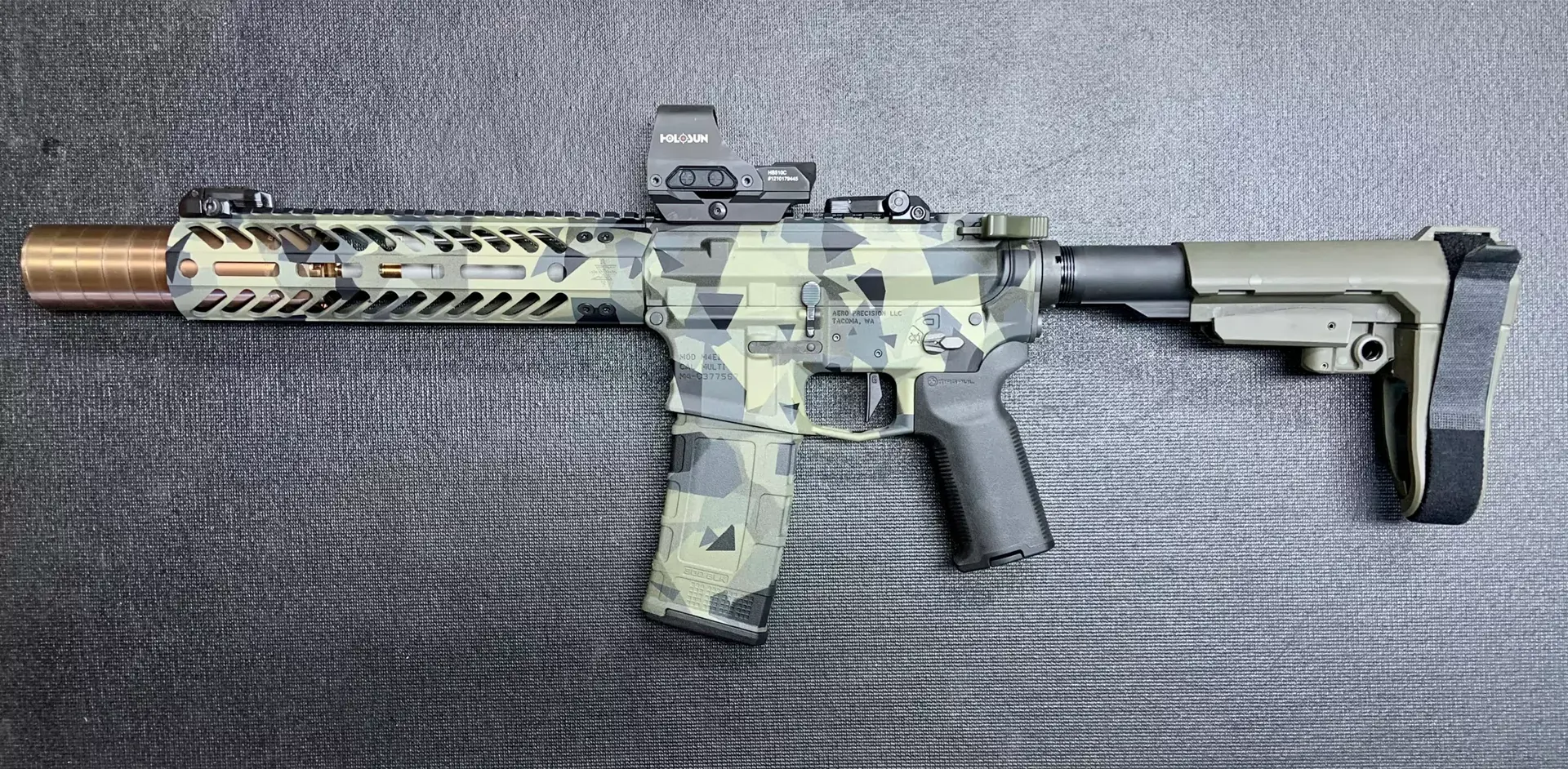
A long-range hunting rifle lives a hard life: rain, dust, brush, freezing glassing sessions, miles in a pack. Two things matter beyond accuracy: that it disappears, and that it endures. A rifle the animal picks out of the terrain at 500 yards is a rifle that never gets a shot, which is why we hand-apply custom terrain-matched camouflage built around the actual ground you hunt rather than a generic factory pattern.
Endurance is the other half. Our air-cure DuraCoat finishes seal the metal against the weather and abuse that strip a factory finish, with no oven required, so optics and polymer get protected in the same job. A rifle that shoots true is worth nothing if it rusts in your truck between seasons. Build the system to survive the conditions you actually hunt.
FAQ
Build the system, then earn the distance
Long-range hunting rewards the patient and punishes the reckless. The rifle, the cartridge, the glass: those are the easy part, and you can buy them this week. The hard part is the verified data, the wind sense, the field positions, and the discipline to pass a shot you haven't earned. That's the work, and it's worth doing right.
If you want to build the whole system (a rifle that's accurate, hidden, and weatherproof, plus the training to run it honestly at distance), that's what we do. Tell us what and where you hunt, and we'll help you build a setup you can trust, then push your skill out to meet it.
Sources
- Boone and Crockett Club, Position Statement: Long Range Shooting, retrieved 2026-06-03, https://www.boone-crockett.org/bc-position-statement-long-range-shooting
- PrecisionRifleBlog.com, Best Rifle Cartridge: What The Pros Use, retrieved 2026-06-03, https://precisionrifleblog.com/2025/09/19/best-rifle-cartridge/