
Coues Deer: The Arizona Hunter's Guide to the Gray Ghost

DuraCoat Certified Applicator · 25+ years
A coues deer is a small, wary subspecies of white-tailed deer native to the mountains of southeastern Arizona and the Southwest, and it is widely considered the most challenging deer on the continent to hunt fair-chase. Hunters call it the "gray ghost," and once you've spent a morning glassing the oak hills and watched one materialize out of nothing and then dissolve back into the shadows, the name stops sounding like marketing. It earns it.
I've lived, built rifles, and hunted in Arizona for more than 25 years. I coat the rifles I build, I match camo to the terrain I actually walk, and I've burned a lot of glass on these deer. So this is the honest local version of the coues guide, not generic whitetail advice from somewhere it rains. Coues deer are their own animal in their own country, and hunting them well is more about your eyes and your patience than your trigger finger.
Here's what matters: what a coues deer is, where they live in Arizona, why they're so brutally hard, how the hunt really works, the rifle and camo setup that fits this terrain, and how to get a tag.
Key takeaways
- Coues deer are a small subspecies of white-tailed deer, nicknamed the "gray ghost," with a salt-and-pepper gray coat, white halos around the eyes, and a white muzzle band (Arizona Game & Fish Department, White-tailed Deer).
- They live in southeastern Arizona's sky island mountains and up onto the Mogollon Rim and the White Mountains, roughly 3,000 to 10,000 feet, in oak woodland, chaparral, and brushy terrain.
- Coues hunting is glassing-intensive spot-and-stalk; you find deer with optics first and cover ground second.
- Rifle hunts are draw-allocated through Arizona Game and Fish and typically fall in October to December, with archery over-the-counter options.
What is a coues deer, exactly?
A coues deer is a small subspecies of white-tailed deer found in the Southwest, and it is genuinely tiny compared to the whitetails most hunters picture. A mature buck can weigh roughly what a big dog weighs, and a trophy set of antlers will fit inside a wreath. That small frame is the first thing that makes them hard, but it's far from the only thing.
You'll know one when you finally pick it apart from the brush. The coat is a soft salt-and-pepper gray, not the red-brown of a Midwestern whitetail, with clean white halos around the eyes and a white band across the muzzle (Arizona Game & Fish Department, White-tailed Deer). That gray is the whole problem. It's the exact color of weathered granite, dead oak, and morning shadow. Evolution painted this deer to disappear into the very ground it stands on, and it works.
Why does a deer this small get such an outsized reputation? Because everything about it (the size, the color, the country, the nerves) is built to defeat a hunter. Bigger game animals forgive mistakes. Coues deer do not.
Where do coues deer live in Arizona?
Coues deer live in the rugged high country of southeastern Arizona's "sky islands," and the population stretches north up onto the Mogollon Rim and into the White Mountains (Arizona Game & Fish Department, White-tailed Deer). The sky islands are exactly what they sound like: isolated mountain ranges that rise out of the desert floor like green islands in a tan sea, each one its own little world of cooler air and thicker cover.
The country they hold runs roughly 3,000 to 10,000 feet in elevation. Down low you're in chaparral and brushy desert transition; climb and you move into oak woodland and eventually pine and the rolling oak-and-juniper benches of the Rim. Coues deer favor that mid-elevation oak country hard, where there's browse, shade, and a thousand folds of terrain to hide in. They like steep, broken ground with a lot of vertical relief, the kind of place where a single canyon can hold a dozen deer you'll never see if you walk through it instead of sitting and looking.
That terrain is the second half of why they're tough. It's beautiful and it's punishing, and it does not give up its deer easily. This is the Arizona country I build and coat rifles for, and it shapes every decision about gear from the ground up.
Why are coues deer so hard to hunt?
Coues deer are hard because three things stack on top of each other: they're small, they live in vast broken terrain, and their senses are razor sharp. Take any one of those away and they'd be an ordinary deer. Together they make the gray ghost.
Start with size. A coues buck offers a tiny target and a tiny silhouette, so even when one is standing in the open at distance, your eyes slide right over it. Then add the country. You're glassing miles of folded, brushy mountainside where the deer is the same color as the dirt. Then add the nerves. Coues deer have the eyesight, hearing, and paranoia of any wary whitetail, dialed up by living in pressured, predator-rich country. They bust at movement you didn't know you made, and once they're gone, they're gone.
Have you ever spent four hours behind a tripod and found exactly one deer, and felt like you'd won? That's coues hunting. The difficulty isn't a marketing line; it's the reason a mature buck is one of the most respected trophies in North American hunting. You don't get lucky into one. You earn it with your eyes.
How does coues deer hunting actually work?
Coues hunting is glassing-intensive spot-and-stalk: you find deer with high-quality optics from a distance, then plan a careful stalk to close the gap, rather than still-hunting or sitting a stand. If you take one thing from this guide, take that. The hunt is won or lost behind the glass before you ever move your feet.
The rhythm goes like this. Before first light you get to a high vantage over the opposite slopes and canyons. You set up a tripod with quality binoculars (and often a spotting scope), and then you grid. Slowly. You break the country into sections and pick each one apart inch by inch, looking for an ear flick, a horizontal back line, a patch of gray that's a shade wrong. Deer feed in the cool of dawn and dusk, so those windows are gold. When you find one, you study it, range it, read the wind and the terrain, and only then commit to a stalk that uses the folds of the ground to get you into position.
The numbers tell the story: serious coues hunters routinely spend far more hours looking than walking, and the best ones own the best glass they can afford. Spotting the deer is most of the battle. The shot, when it finally comes, is often the easy part, and it's frequently a longer one across a canyon than you'd take on other game. That reality drives the whole rifle build. If you want to understand the discipline behind those longer shots, I've written a full breakdown of ethical long-range hunting that applies directly here.
What's the right rifle and camo setup for coues deer?
The right coues rig is a flat-shooting, long-range-capable precision rifle wearing terrain-matched camouflage and a weatherproof finish, because this is open mountain country where shots stretch out and concealment is constant. You're not slipping through timber at 80 yards. You're often making a deliberate shot across a drainage at distance, after a stalk that put you in plain sight of a paranoid animal.
So the rifle wants accuracy and a cartridge that shoots flat and carries honest energy to the ranges you'll actually shoot, paired with glass you trust and verified data on the turret. A coues deer is small, the vital zone is smaller, and the distances can be long, which leaves zero room for a rifle that doesn't hold its zero or a shooter guessing at his come-ups. Practice and confirmed DOPE matter more than headstamp.
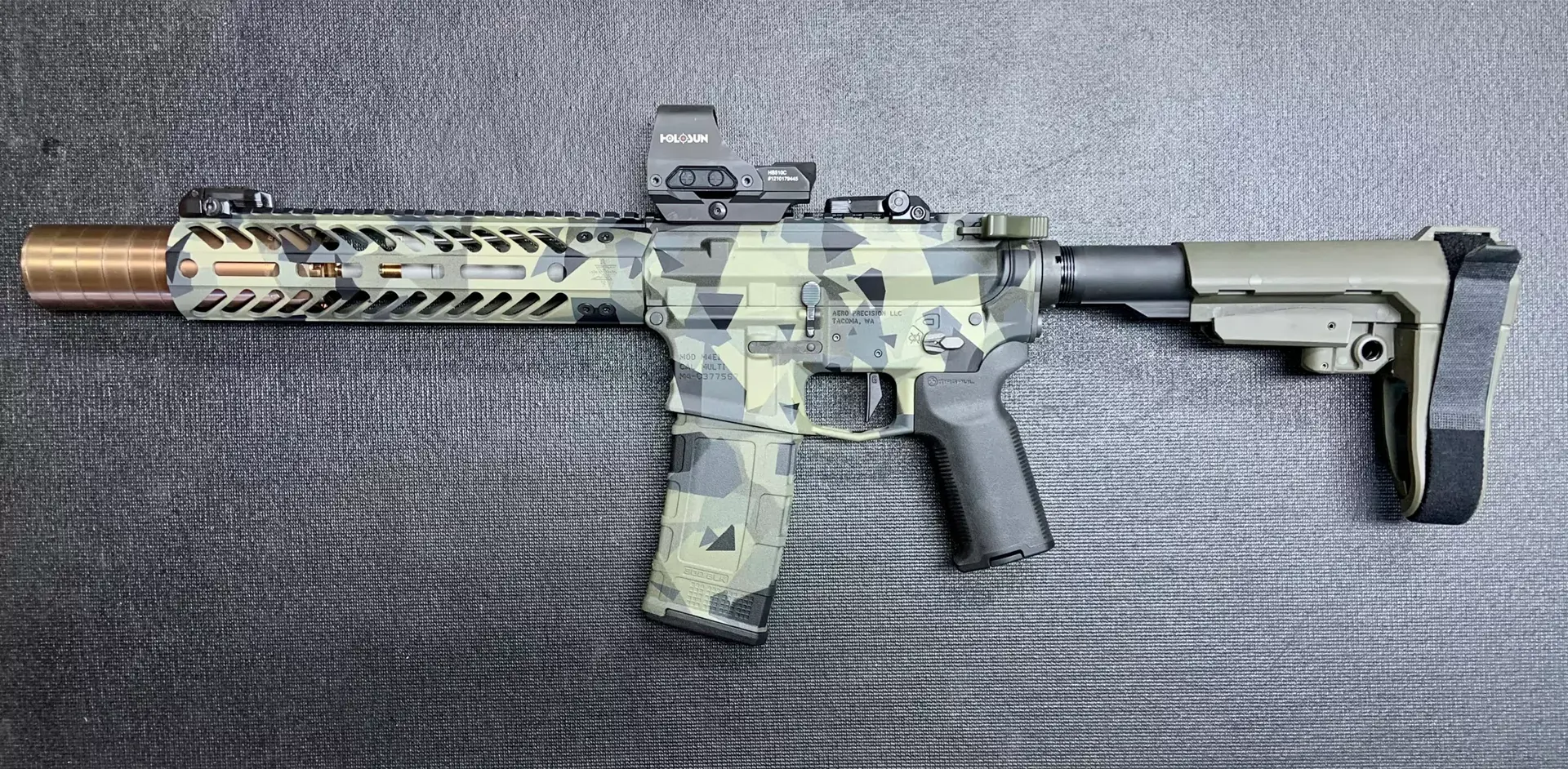
Now the part most guides skip: concealment. In sky-island terrain there's no tree to break your outline, and you're trying to hide from an animal whose entire defense is its eyes. A factory black rifle or a glossy stock flashes in that low desert light like a mirror. This is where a hand-applied terrain-matched camo finish genuinely changes the math. We build custom camouflage patterns keyed to the gray granite, oak, and chaparral palette of the country you're actually hunting, so the rifle disappears into the same ground the deer is using.
Finish does double duty here, too. Arizona's high country swings from frost to heat and dust in a single morning, and sweat, brush, and weather chew up bare metal fast. A durable DuraCoat protective coating seals the steel against corrosion and abrasion while carrying the camo, so the rifle that hides also survives the season. If you want the local specifics on how these finishes hold up in our climate, that's the whole point of our work on Arizona firearm coatings. And if your shooting needs to catch up to your rifle's reach, our precision rifle training is built to push your honest field range out to meet the country.
How do you get a coues deer tag in Arizona?
You get a coues rifle tag through the Arizona Game and Fish Department's draw, and you should go straight to the source for the current rules rather than trust any blog (including this one) on the specifics. Rifle hunts for coues whitetail are draw-allocated and typically fall in the October to December window, with archery hunts available over the counter (Arizona Game & Fish Department, White-tailed Deer).
Beyond that, I'm not going to feed you draw odds, unit recommendations, or season dates that change year to year. Units, application deadlines, bonus points, and tag numbers are set by AZGFD and shift annually, so read the current draw information directly from Arizona Game and Fish before you plan. Want to hunt this fall? Start with the draw calendar now, because the application windows close long before the season opens. The deer will wait. The deadline won't.
FAQ
Build the rifle the country demands
Coues deer don't reward the hunter with the most gear. They reward the one who sees first, hides best, and makes a clean shot when the canyon finally gives one up. The eyes and the patience are on you. The rifle, though, we can build right.
If you're chasing the gray ghost this season, give yourself a rig that disappears into Arizona's oak and granite and survives the season doing it: a custom terrain-matched camo finish, a durable protective coating, and a precision build with the training to run it honestly at distance. Tell us where you hunt and what you're after, and we'll help you put together a setup the country can't pick apart.
Sources
- Arizona Game and Fish Department, White-tailed Deer, retrieved 2026-06-04, https://www.azgfd.com/species/white-tailed-deer/