Is There a Better Alternative to Cerakote? An Honest Take After 25 Years

DuraCoat Certified Applicator · 25+ years
Every few weeks someone emails me a version of the same question: "I keep hearing Cerakote is the gold standard. Is there anything better, or am I stuck with it?" Fair question. Cerakote is a good finish. It's also marketed harder than anything else in the industry, and that's a very different thing from being the only good answer.
I've been hand-applying firearm finishes since 2000. Twenty-five years at the spray gun, a DuraCoat-certified applicator, and, full disclosure, I don't run Cerakote in my shop. So read this knowing I've got a horse in the race. I'm going to be straight with you anyway, because the honest answer is more useful than the sales pitch.
So is there a better alternative to Cerakote? The short version: "better" depends entirely on what you're trying to do, and the coating you pick matters less than the hands applying it. Let me show you what I mean.
The short answer
- "Better than Cerakote" is the wrong question. Better for what is the right one: optics, polymer, camo, budget, and DIY-versus-pro each change the answer.
- Cerakote's H-Series cures in an oven at 250°F for two hours (Cerakote H-Series Technical Data Sheet, NIC Industries, 2021). That oven is the whole reason it can't safely touch your LPVO, suppressor, or polymer stock.
- The biggest predictor of how long any finish lasts isn't the brand on the can. It's surface prep and the person doing the work.
First, what "better than Cerakote" actually means
Here's a number that reframes the entire debate: as of 2026, Cerakote's flagship H-Series still cures in an oven at 250°F for two hours, or 300°F for one (Cerakote H-Series Technical Data Sheet, NIC Industries, 2021). Hold onto that, because nearly every meaningful tradeoff between firearm finishes traces straight back to heat.
When somebody asks me for something "better," they almost always mean one of five things. More durable. Cheaper. Able to coat the parts an oven would ruin: glass, cans, polymer. Better looking, usually meaning real camouflage. Or DIY-able on a Saturday. Those are five different goals, and they point at five different finishes. Lumping them under one word is how people end up with the wrong coating on the right gun.
So instead of crowning one winner, let's walk the real options and match each to the job it's actually good at.
The real alternatives to Cerakote, ranked by what they're good for
There are maybe seven finishes worth discussing seriously, and a couple more worth mentioning so you know to skip them. None of them is "the best." Each trades something. Here's the honest rundown.
DuraCoat: the air-cure alternative I stake my name on
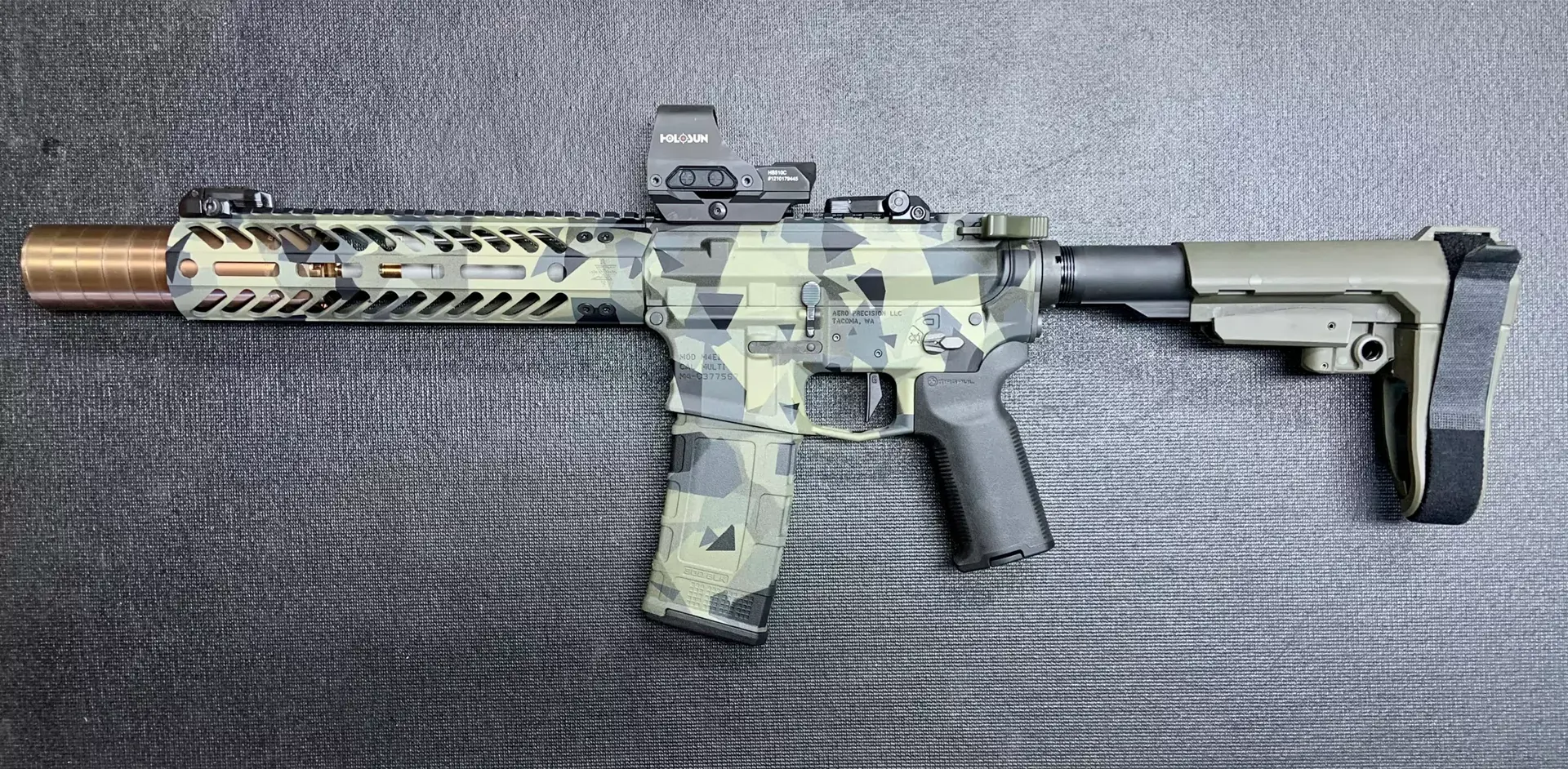
This is what I shoot, so weigh it accordingly. DuraCoat is a two-part chemical coating that air-cures at room temperature. No oven, no heat. It meets MIL-DTL-53039, the same military abrasion spec the tough stuff is held to, and it comes in north of 300 colors. Because there's no bake cycle, I can coat your optic, suppressor, polymer stock, and bipod in the same job as the receiver. The honest tradeoff? It's soft until it fully cures, so it demands patience and a clean process. Done right, it's milspec-hard and it does not yellow. I lay out the full head-to-head on the DuraCoat versus Cerakote comparison page.
Anodizing and Type III hardcoat: brilliant, but only on aluminum
Anodizing isn't a coating sitting on top of the metal. It's a conversion of the aluminum's own surface, which makes it integral and genuinely hard. For an AR upper or a billet handguard, hardcoat anodizing is fantastic and basically permanent. The catch is right there in the definition: it only works on aluminum. Your steel barrel, your bolt, your slide? Anodizing can't touch them. It's a piece of the puzzle, not a whole-gun answer.
Nitride, Melonite, and QPQ: factory-tough, but you can't get it at a shop
Salt-bath nitriding (sold as Melonite, Tenifer, QPQ, and a dozen other names) is a heat-treat process that hardens the steel itself and leaves a satin black surface that shrugs off rust. It's superb; it's why so many factory barrels and slides last forever. But it's metallurgy, not paint. It happens at the factory in a molten salt bath, it's black and only black, and there's no recoloring or camo in your future. If your gun already wears it, great. You're not adding it after the fact in any practical way.
GunKote and moly resin: the thin bake-on middle ground
KG GunKote and the moly-resin products are thin, bake-on polymer coatings that land somewhere between rattle-can and the premium finishes. They go on thin, which is nice for tight-tolerance parts, and a careful hobbyist can get respectable results at home with a toaster oven and patience. They're just not as tough or as thick-film forgiving as the top-tier coatings, and the color range is narrow. A reasonable DIY pick, not a forever finish.
Hydrographics and vinyl wraps: looks, not armor
Hydro dipping and stick-on wraps like GunSkins solve a different problem: appearance. A vinyl wrap is cheap, removable, and great if you want woodland today and black next month, but it's a sticker, not protection. Hydrographics can look incredible, yet the pattern still needs a durable topcoat to survive holster wear. If your goal is protection that happens to look good, these are backwards. If your goal is looks with zero permanence, they're perfect.
Bluing and the rattle-can: know what you're buying
Traditional rust bluing is beautiful on a classic blued revolver and offers almost no real corrosion protection without constant oiling. A can of grill paint will absolutely change a beater's color for twenty bucks, and it'll start chipping the first time it kisses a truck gun rack. Neither is wrong. Just don't expect either to behave like a coating that's engineered to last a decade.
The part the marketing skips: application beats the brand
Joel coated the roof rack on his own Toyota Tundra eight years ago, and it's still holding in full Arizona sun, never garaged, never babied. That's not a coating miracle. That's prep and application doing their job. And it's the single most important thing I can tell you in this whole article.
I've stripped a lot of failed finishes off other people's guns over twenty-five years. Cerakote, DuraCoat, GunKote: I've seen all of them peel, chip, and bubble. Want to know what almost every failure has in common? It isn't the brand. It's a rushed prep: a receiver that didn't get fully degreased, no adhesion test, no bond promoter, film built too thick or too thin. A premium coating sprayed over a greasy part fails fast. A "lesser" coating over a perfectly prepped surface lasts for years.
Our finding, after 25 years at the gun: the coating is maybe 30% of the result. The other 70% is surface prep and the hand laying it down. Pick your applicator before you pick your finish.
That's why every job in my shop carries a flat surface-prep step before any color goes on: full solvent degrease, adhesion test, bond promoter, final wipe. It's the boring part nobody photographs, and it's the part that decides whether your finish is still perfect in 2036. The same prep, incidentally, is what we run as a standalone ultrasonic firearm cleaning service.
So which finish is actually better, for you?
Let me make this concrete, because "it depends" is a cop-out without specifics. Here's how I'd route the most common builds that land on my bench.
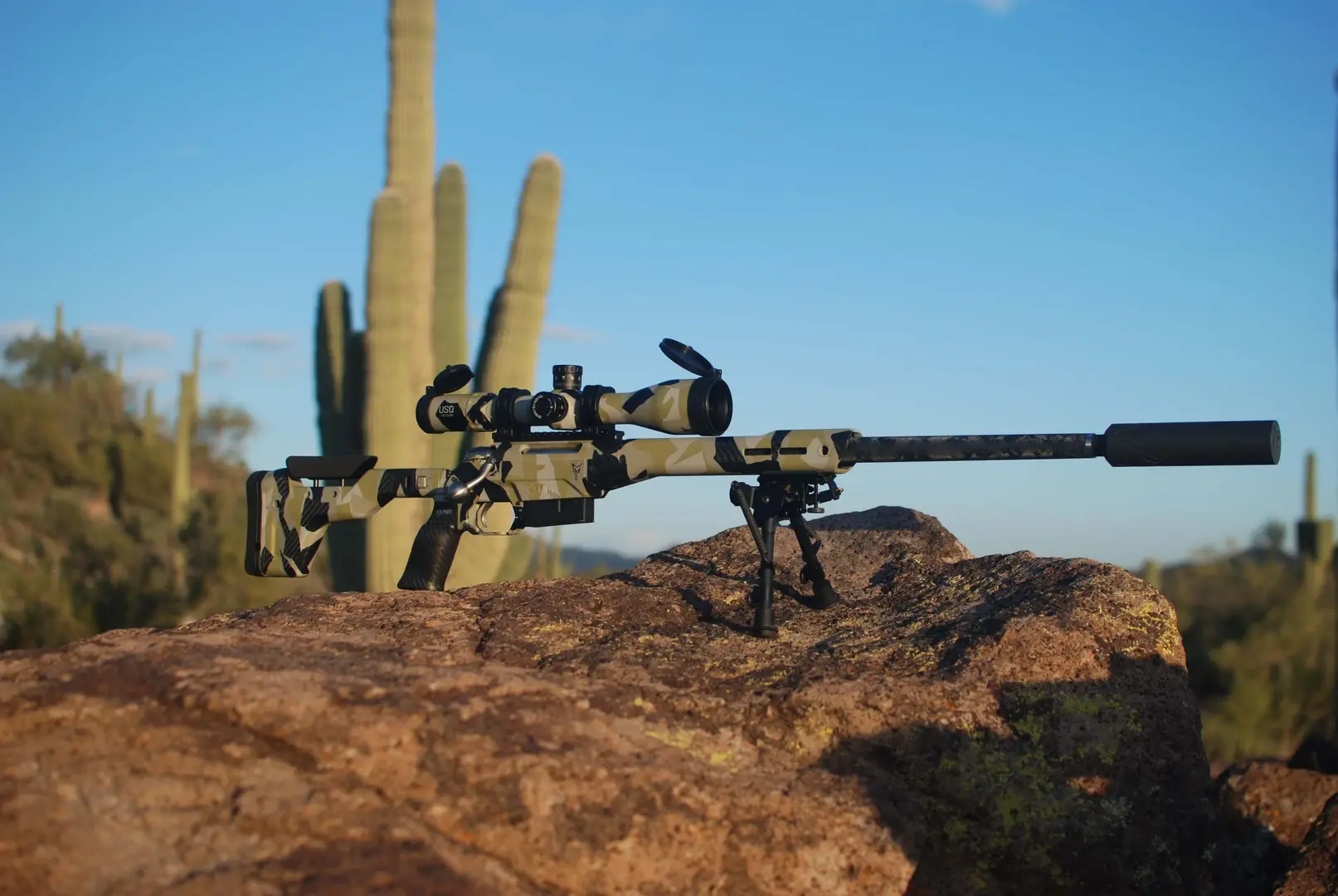
A hunting rifle that needs to disappear. You don't want a solid color, you want the rifle to read as terrain. That's hand-applied custom camouflage, built around the actual ground you hunt, and it's the one job where an oven-cured finish is genuinely impractical, since every freehand layer would need its own bake. Send me photos of where you hunt and we build the custom camouflage pattern from scratch. I get deeper into terrain matching on the hunting camouflage page.
A precision rig with glass, a can, and a bipod you want to match. This is the air-cure use case. Because there's no oven, the optic, suppressor, and bipod go through the coating process in the same job as the barreled action, and the whole rig matches. Try that with a 250°F bake and you'll be shopping for a new scope.
An everyday-carry pistol slide. Honestly? Both Cerakote and DuraCoat do this well. It's a small, all-steel part with no heat-sensitive bits, so the heat penalty doesn't apply. Pick the shop with the better prep and the better portfolio.
A budget beater you don't baby. Rattle-can or moly resin, do it yourself, and enjoy the worn look when it comes. Just don't pay premium money expecting premium life out of a hobby finish.
What a professional alternative actually costs
People assume the pro route is wildly expensive. It isn't. In my shop, solid-color handgun work runs $120 per color and rifles run $150 per color, plus a flat $50 surface-prep fee, so a two-color contrast slide and frame lands around $290, and a four-color layered hunting pattern on a rifle is about $650. There's a no-limits "Balls to the Wall" build at $1,200 flat for a single rifle with unlimited colors, and a $250 shop minimum.
Those prices include the whole rig (barreled action, stock, optic, suppressor, bipod, bottom metal) with no "just the receiver" pricing games. Standard turnaround is one to two weeks from the day your firearm hits the bench. The full breakdown, with examples, lives on the gun coating cost page. Compare that to a weekend of DIY plus a redo when the first attempt chips, and "cheaper" starts to look different.
FAQ: Cerakote alternatives, answered
Got a rifle you want coated?
If you're trying to decide between finishes for a specific build, skip the forum guessing. Send a few photos and the color or pattern you have in mind through the contact page, and we'll come back with a price and a realistic timeline within 24 hours. Twenty-five years in, the best advice I can give still fits on a bumper sticker: pick the applicator first, the finish second.
Sources
- Cerakote (NIC Industries), H-Series Technical Data Sheet, retrieved 2026-06-03, https://images.nicindustries.com/cerakote/documents/405/h-series-tds-dt20210623153653615.pdf
- Carnimore, DuraCoat vs Cerakote, retrieved 2026-06-03, https://carnimore.com/duracoat-vs-cerakote
- Carnimore, Gun Coating Cost, retrieved 2026-06-03, https://carnimore.com/gun-coating-cost