
Do You Need an Oven to Cerakote a Gun? (And the No-Oven Alternative)

DuraCoat Certified Applicator · 25+ years
Short answer: yes. To cure Cerakote's flagship H-Series the way the manufacturer specifies, you bake the part in an oven at 250°F for two hours, or 300°F for one (Cerakote H-Series Technical Data Sheet, NIC Industries, 2021). That bake isn't a suggestion or a "nice to have." It's how the coating chemically hardens. Skip it and you don't have a finish; you have wet paint that scratches off the first time you rack the slide.
I've been hand-applying firearm finishes since 2000. Twenty-five years at the spray gun, a DuraCoat-certified applicator, and full disclosure: I don't run Cerakote in my shop. So I've got a horse in this race, and I'll tell you up front. I'll still be straight with you, because the oven question matters more than most people realize, and the honest version is more useful than a sales pitch.
Here's why that bake cycle is the whole story. It's why DIY Cerakote is harder than the YouTube videos make it look, why your scope and suppressor and polymer stock can't ride along in the same job, and why an air-cure alternative exists at all (it's what I shoot). Let me walk you through what the oven actually costs you, and when you can skip it.
Key takeaways
- Cerakote's H-Series cures in an oven at 250°F for two hours, or 300°F for one (Cerakote H-Series Technical Data Sheet, NIC Industries, 2021). The bake is not optional; it's how the coating hardens.
- That heat is why oven-cured finishes generally can't touch optics, suppressors, or polymer; 250°F-plus damages lenses, internal coatings, and plastic.
- DIY Cerakote means buying a dedicated oven, an airbrush or HVLP setup, and a spray space, then nailing the prep. The cost and failure rate surprise most first-timers.
- There's an air-cure path: hand-applied DuraCoat cures at room temperature, no oven, and coats heat-sensitive parts in the same job.
Does Cerakote really need an oven?
Yes, and it's worth being precise about why, because the internet is full of people who half-remember the answer. Cerakote's H-Series, the line most shops use for firearms, is engineered to cross-link and harden under heat. The published schedule is 250°F for two hours or 300°F for one (Cerakote H-Series Technical Data Sheet, NIC Industries, 2021). Until the part hits that temperature for that long, the coating hasn't actually become what it's supposed to be.
There are air-dry Cerakote products in the catalog (the C-Series), but the finish that built the brand's reputation for toughness is the oven-cured one. So when somebody says "Cerakote is the gold standard," they're talking about a coating that lives or dies by a bake cycle.
What does that mean in practice? Heat is the gatekeeper for everything that follows: the parts you can coat, the parts you have to leave off, the gear you need to do it yourself. It all traces back to that oven. Hold onto that, because the rest of this article is really just the consequences of one number, 250 degrees.
Why the oven requirement matters more than you'd think
The oven sounds like a minor logistics detail. It isn't. It quietly decides what can and can't go into the job, and that's the part that bites people.
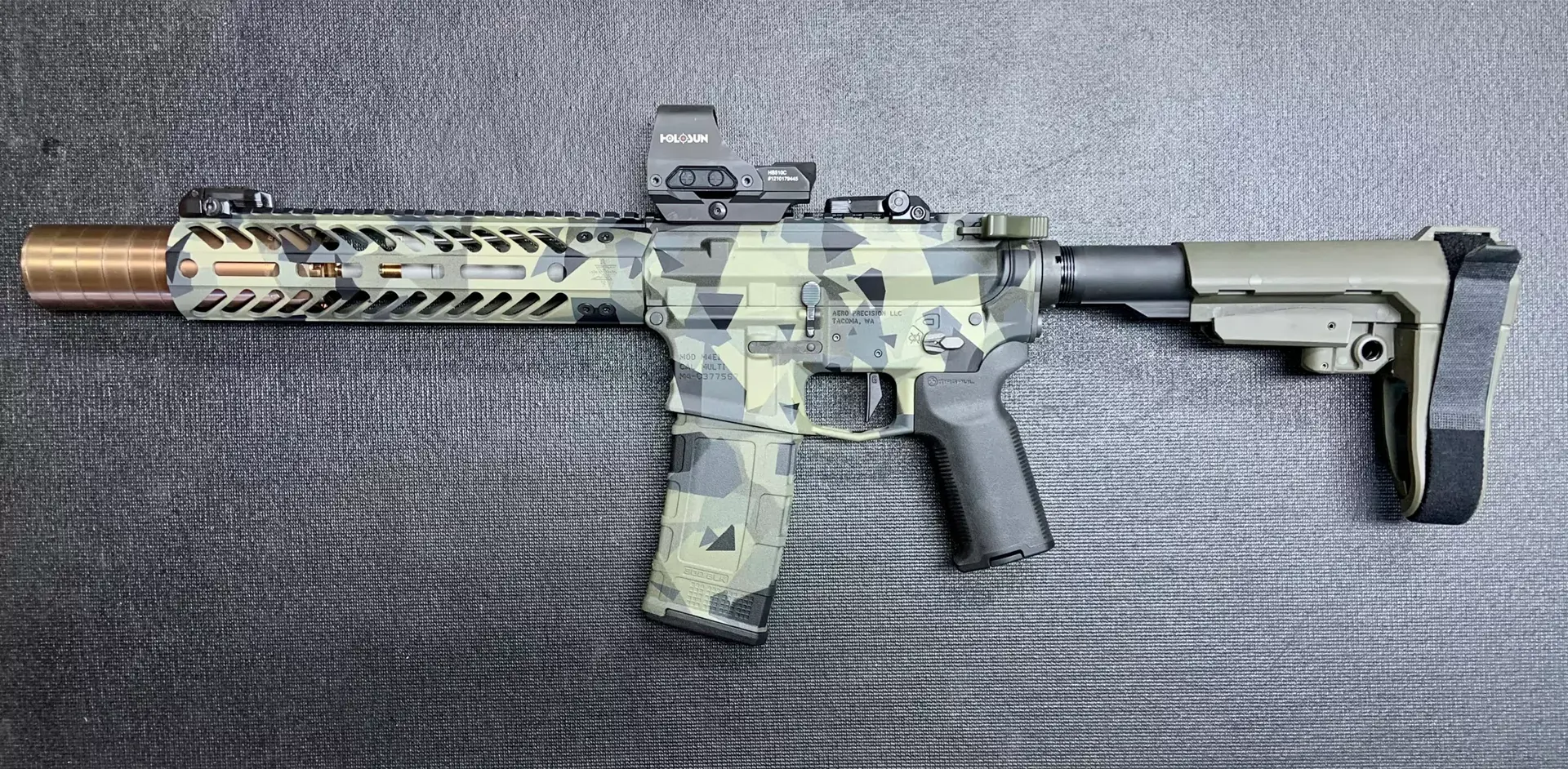
Think about what's on a modern rifle. The barreled action and bottom metal are all steel and aluminum, happy in an oven. But there's also the glass (your LPVO, your Aimpoint, your red dot), the suppressor with its internal coatings, and the polymer (the stock, the grip, maybe the magazine). Now picture baking all of that at 250°F to 300°F for an hour or two. Lenses and their internal coatings don't survive that heat well, and polymer softens and warps. So they can't go in the oven, which means an oven-cured finish generally can't coat them at all, at least not in one matched job.
Want your scope to match your rifle? With an oven coating, you're stuck. The barreled action gets baked; the optic stays whatever color it came in. That's not a knock on the people doing the work; it's physics. You cannot heat a lens to 300 degrees and expect it to be the same lens afterward.
This is also where DIY gets genuinely hard. The oven isn't just a constraint on parts. It's equipment you have to own, run, and dedicate. Let's talk about what that takes.
What does it actually take to Cerakote at home?
More than a single can and a free Saturday, which is what trips most people up. To Cerakote a gun at home and have it come out right, here's the honest list of what you're signing up for.
First, the oven. A dedicated one, not your kitchen oven, because you're curing chemical coatings and you don't want those fumes near food. Most DIYers buy a used electric or powder-coating oven big enough to hold a barreled action, which is bigger than you'd guess. Toaster ovens won't fit a rifle.
Second, spray equipment. Cerakote goes on through an airbrush or small HVLP gun, which means a compressor with a moisture trap, the gun itself, and the skill to lay down an even, thin film. Too thick and it runs or won't cure right; too thin and coverage suffers. That control takes practice before you point it at a gun you care about.
Third, a spray space. You don't want atomized coating drifting through the garage and settling on the car, and you don't want to breathe it, so you're looking at a ventilated booth and a proper respirator.
Fourth, and everyone underestimates this one, the prep. The finish is only as good as the surface under it: a full degrease, blasting or abrading to profile the metal, masking every hole and threaded surface, and keeping the part contamination-free right up to spray. One greasy fingerprint and you've got a failure waiting to happen.
So what does it cost? I won't quote a number for someone else's setup; it swings wildly with what you already own. But by the time you've got a dedicated oven, a compressor and gun, a booth, a respirator, blast media, the coating itself, and the parts you'll ruin learning, the first gun you finish at home is rarely the cheap project it looked like. Is it doable? Absolutely, plenty of hobbyists do it well. Is it the casual afternoon the marketing implies? Not even close.
Is there a gun coating that doesn't need an oven?
Yes, and this is the part I actually know cold, because it's what I do every day. There's a whole category of air-cure coatings that harden at room temperature with no heat at all. The one I stake my name on is DuraCoat.
DuraCoat is a two-part chemical coating that air-cures at room temperature. No oven, no bake, no heat. You mix it, you spray it, and it cures through a chemical reaction over time instead of in a hot box. That single difference (room-temp cure instead of a 250-degree bake) flips the whole script on what I can coat.
Because nothing goes in an oven, I can finish the heat-sensitive parts in the same job as everything else. Your optic, your suppressor, your polymer stock, your bipod: they all go through the coating process right alongside the barreled action, and the whole rig comes back matching. The Aimpoint matches the receiver matches the stock. Try that with an oven coating and you'd be shopping for a new scope.
Is air-cure a free lunch? No. It's soft until it fully cures, so it demands patience and a genuinely clean process; you can't rush it. But done right, it's milspec-hard. DuraCoat meets MIL-DTL-53039, the same military abrasion standard the tough oven coatings are measured against, and it doesn't yellow over time. How do I know it lasts? I coated the roof rack on my own Toyota Tundra with it eight-plus years ago. It rides in direct Arizona sun, never garaged, never babied, and it's still holding. If it can take a decade of desert sun on a truck, it can take your holster. I lay out the full comparison on the DuraCoat versus Cerakote page, and dig into why air-cure wins for optics-heavy builds in my breakdown of the better alternative to Cerakote.
DIY at home or send it to a pro?
Let me be fair, because I'm obviously biased and you deserve the honest version. DIY coating is a legitimate, rewarding hobby. If you like the process, you've got a spare garage, you don't mind buying the gear, and your first project is a beater you won't cry over, go for it. Some hobbyists get results that rival a shop, and there's real satisfaction in finishing your own rifle.
But here's the math people skip. The pro route isn't the luxury splurge it's made out to be. Tally a dedicated oven, a spray gun, a booth, a respirator, blast media, and the coating, then add practice parts and the near-certain redo on your first attempt, and the DIY "savings" shrink fast. A shop already owns all of that, has sprayed thousands of guns, and knows how the coating behaves on a humid day versus a dry one.
The single biggest predictor of how long any finish lasts isn't the brand on the can or the oven temperature. It's the surface prep and the hands doing the work. I've stripped a lot of failed finishes off other people's guns over 25 years, every brand, and almost every failure traced back to rushed prep, not the coating. That's the part that's hard to replicate at home on your first try.
So my honest routing: if it's a learning project on a cheap gun and the journey is the point, DIY it. If it's a precision rig with glass and a can you want matched, or a carry gun you need to actually trust, send it out. And whichever you pick, vet the prep before the finish. The same careful prep we run before any color, by the way, is available on its own as our ultrasonic firearm cleaning service, and it's also the foundation under every custom camouflage job that leaves the bench.
FAQ
Got a build you want coated?
If you're weighing the oven hassle against just sending it out, skip the forum guessing. Tell me the gun, the parts you want matched, and the color or pattern you have in mind through the contact page, and I'll come back with a realistic price and timeline. Curious what the pro route runs before you reach out? The full breakdown lives on the gun coating cost page. Twenty-five years in, the best advice I've got still fits on a bumper sticker: pick the applicator first, the finish second.
Sources
- Cerakote (NIC Industries), H-Series Technical Data Sheet, retrieved 2026-06-04, https://images.nicindustries.com/cerakote/documents/405/h-series-tds-dt20210623153653615.pdf