
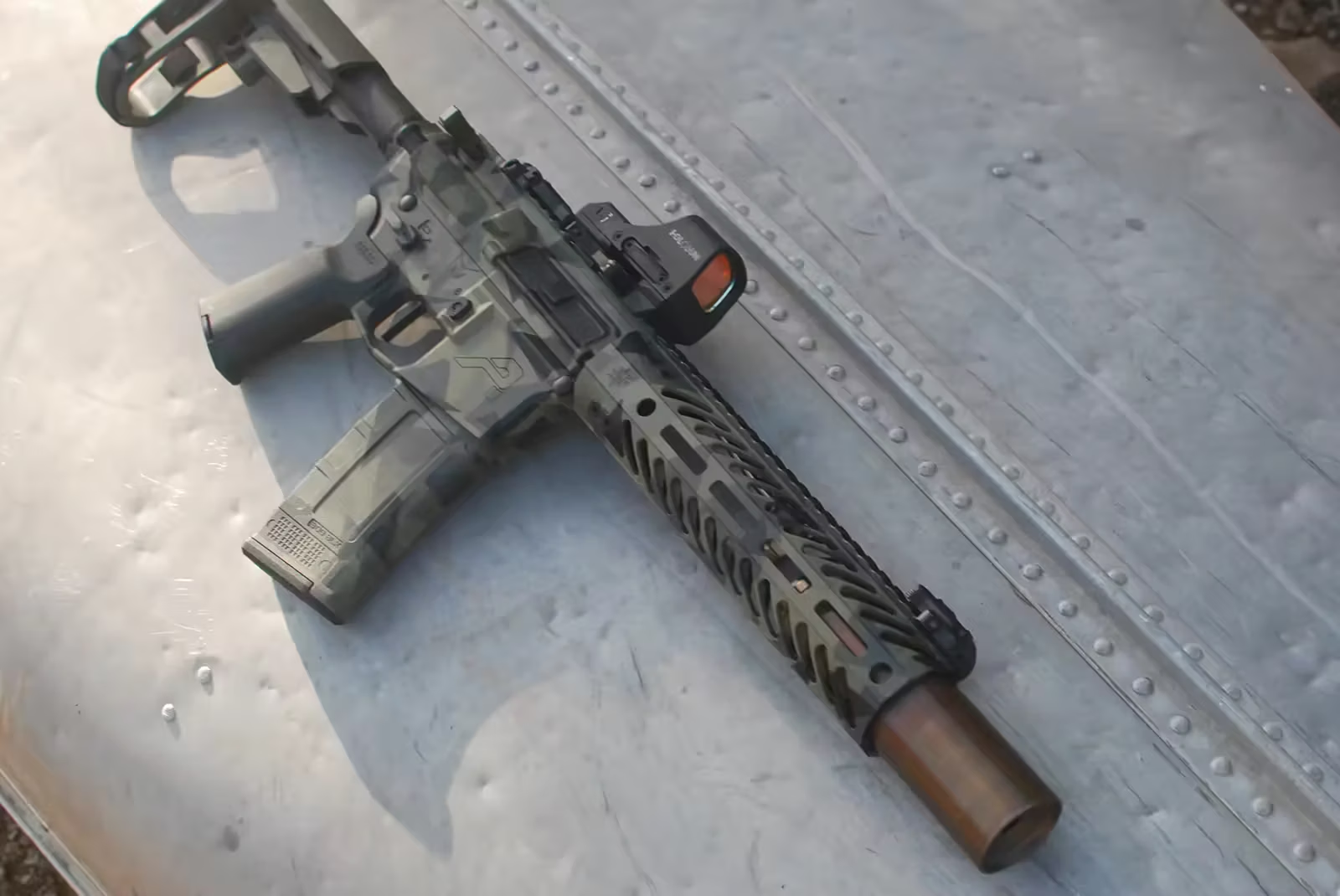
Cerakote vs
Powder Coating.
Powder coating is the tougher coating. It is also, on almost every firearm, the wrong one. Here is exactly why, and what the thickness numbers actually do to your gun.
DuraCoat Certified Applicator · 25+ years of reps ·
The Short Answer
Powder coating builds a thicker, tougher film than Cerakote. On a firearm that is a liability, not an advantage. The entire comparison comes down to one number: film thickness.
- Powder coat lays down 2 to 4 mils. Cerakote lays down under 1 mil. On mating parts you gain that thickness twice, once on each surface.
- That thickness fills engraving, roll marks, and checkering, and it binds anything machined to close tolerance.
- Powder cures near 400F, which is hotter than Cerakote and rules out optics, polymer, springs, and adhesives outright.
- Powder coat is genuinely excellent on bumpers, roll cages, and brackets. Those parts have no fitted tolerances to protect.
- Neither one can coat your optic or stock. If you want the whole rig finished as a system, both are the wrong tool and you want an air-cured finish.
It is all about thickness.
A mil is one thousandth of an inch. Powder coating typically lands between 2 and 4 mils. Cerakote usually comes in under 1. Those sound like rounding errors until you remember that firearms are assemblies of parts machined to fit each other, and that every fitted joint has two coated surfaces facing one another.
Coat both halves of a slide and frame in powder and you have added something in the range of 4 to 8 mils across that interface. That is more than enough to turn a smooth action into one that drags, or to stop it cycling at all. The same math applies to a bolt in a raceway, a barrel extension, a threaded muzzle device, and anything that has to index in a repeatable position.
The workaround is masking, and shops that powder coat firearms do a lot of it. Every tolerance-critical surface gets plugged, taped, or capped before the part goes in. That works, but it is slow, it moves the wear boundary to a hard masked edge, and it means large areas of your gun are not actually protected.
What thickness costs you cosmetically.
Powder coat flows out when it bakes, which is what gives it that deep, even, slightly rounded automotive look. On a car part that is exactly what you want. On a firearm it softens every crisp edge, fills roll marks and proof stamps, and turns checkering or stippling noticeably shallower. Collectors care about this a great deal, and it is not reversible without stripping.
Where they actually differ.
When each one wins.
Pick Powder Coating
For parts with nothing to protect.
- Automotive and off-road components, bumpers, roll cages, brackets.
- Range equipment, target stands, and steel gongs.
- Ammo cans, tool boxes, and shop fixtures.
- Anything where maximum film toughness matters and fit does not.
Pick Cerakote
For all-metal firearms in one color.
- Full-metal firearms with the optic and stock removed.
- Single solid colors where markings need to stay crisp.
- Fitted assemblies that cannot tolerate added film.
- Suppressors and barrels, using the high-heat C-Series line.
Neither one can coat your whole rig.
Both of these processes end in an oven. That is the shared constraint people tend to miss while comparing them against each other. Whichever one you pick, your optic comes off, your polymer stock comes off, your suppressor usually comes off, and those parts either stay their original color or get handled some other way.
We run DuraCoat, which air-cures at room temperature. That is not a claim that it is harder than powder coat, because it is not. It is a different trade: we give up some raw film toughness and in exchange we can finish the rifle, the glass, the stock, the bipod, and the can as one matched system, and layer a camouflage pattern across all of it. For a working field rifle that trade is usually worth making. For a bumper it absolutely is not.
Cerakote vs powder coating FAQ.
What is the difference between powder coating and Cerakote?
Powder coating is an electrostatically applied dry polymer that is baked until it flows out into a thick, tough shell, typically 2 to 4 mils. Cerakote is a sprayed ceramic-filled liquid that cures far thinner, usually under 1 mil. Powder coat is the tougher film in a lab. Cerakote is the one that fits a firearm without changing how the parts fit together.
Can you powder coat a gun?
Physically yes, and people do it, usually on AR receivers and shotgun barrels. The problems are practical rather than chemical. The film is thick enough to fill engraving and roll marks, it binds parts machined to close tolerance, and the bake runs near 400F, which rules out optics, polymer, springs, and most anything with an adhesive in it.
Is powder coating more durable than Cerakote?
In raw abrasion and impact resistance, powder coat generally wins because it is a much thicker film. That advantage does not transfer to firearms, where the thickness is the problem. On a bumper or a roll cage, powder coat is the better answer. On a bolt body or a barrel extension, the extra film is a defect rather than a feature.
Does powder coating affect firearm tolerances?
Yes, and this is the main reason shops avoid it. At 2 to 4 mils per surface, two mating parts gain double that across the joint. Slides bind in frames, bolts drag in raceways, and threaded components stop timing correctly. Anything that has to slide, rotate, or index is at risk.
What temperature does powder coating need?
Most firearm-suitable powders cure somewhere around 350F to 400F for 15 to 20 minutes. That is hotter than a Cerakote H-Series bake and well past what optics, polymer stocks, suppressor internals, and many springs tolerate. Heat-treated small parts can also lose temper at those temperatures.
Which finish is cheaper?
Powder coating is usually cheaper per part, because the process is fast and the material is inexpensive. The saving tends to disappear once you account for masking every tolerance-critical surface, stripping and redoing anything that binds, and the fact that the optic and stock cannot go through the oven and need a separate solution anyway.
Can powder coating be repaired?
Not easily. There is no practical way to blend a spot repair into a cured powder coat film. Fixing a chip generally means stripping the component back to bare metal and running the whole bake cycle again.
Not sure what your
rig actually needs?
Tell us what you shoot and how you use it. We will tell you honestly which finish fits, even when the answer is one we do not sell.
Get a Free Quote →